
 Cart is empty
Rabbit farming can be profitable in Kenya when well managed and costs are controlled. With relatively low space requirements, moderate startup capital, and fast reproduction cycles, rabbits offer a practical entry point into livestock farming.
Based on typical production assumptions, a farmer starting with 10 does can begin making sales around month five, recover their initial investment in about a year, and generate consistent monthly income thereafter. Scaling up increases total returns, as revenue grows in proportion to the number of breeding does.
This guide breaks down:
- Startup costs (breeding stock and cages)
- Monthly running costs (mainly feed)
- Income projections at three scales: 10, 20, and 50 does
Note: All figures are based on current Kenyan market estimates and standard production assumptions. Actual results may vary depending on management, feed quality, and mortality rates.
You Don’t Have to Figure This Out Alone: What Rabbit Choice Farms Offers
One of the most common reasons farmers fail to get started or fail to scale is that they try to piece together the operation from scratch: sourcing breeders from unknown suppliers, building cages without guidance, and selling meat with no guaranteed market. Rabbit Choice Farms exists to remove every one of those obstacles.
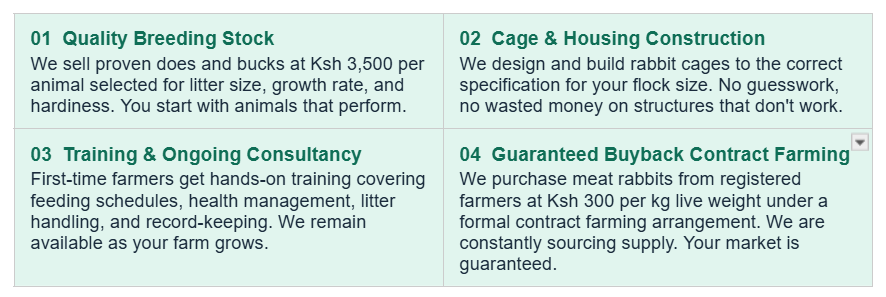
We offer a complete end-to-end service for rabbit farmers at every stage:
Whether you are planning your first 10 does or scaling to a 50-doe commercial operation, you do not need to start from zero. Contact us before you spend a single shilling and we will help you plan the right farm for your space, budget, and income targets.
| Guaranteed market for your rabbits. Rabbit Choice Farms operates a contract farming programme. Once registered, you are guaranteed a buyer for every meat rabbit you produce at Ksh 300 per kg live weight, collected directly from your farm. We are constantly sourcing supply and the demand for rabbit meat in Nairobi consistently outstrips what local farmers produce. Your output has a home before your first doe even kindles. |
What Does It Cost to Start a Rabbit Farm in Kenya?
Your startup costs fall into two categories: breeding stock and cages. Both are one-time capital outlays after that, your running costs are primarily feed.
- Breeding Stock
Purchase your does and bucks from a reputable supplier. Rabbit Choice Farms sells quality breeders at Ksh.3,500 per animal. The correct buck-to-doe ratio is 1:5 – one buck can service five does efficiently. Overstocking bucks is one of the most common and easily avoidable startup mistakes.
- Cage Construction
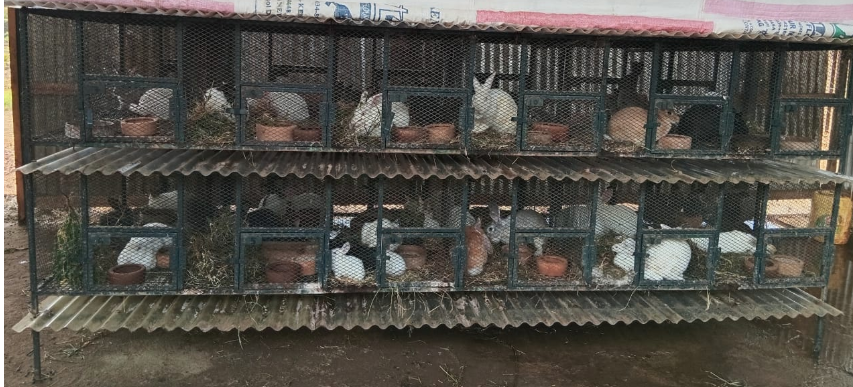
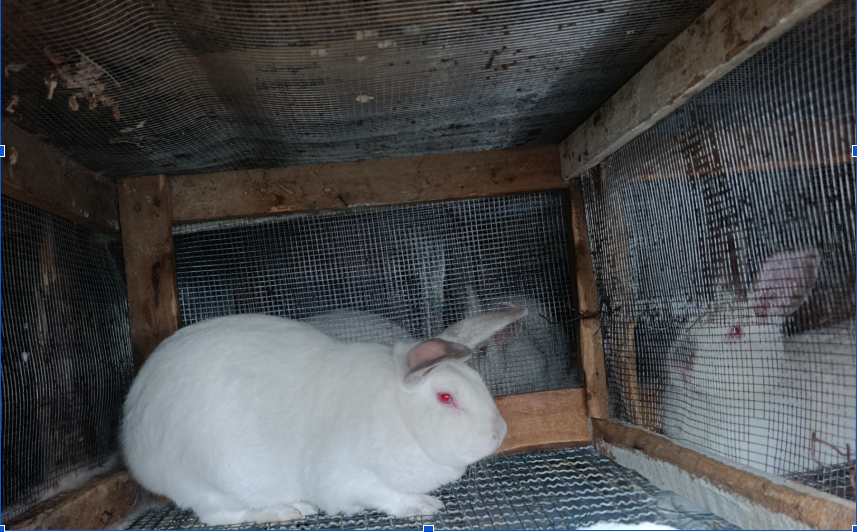
Each doe needs 3 cages, one for the doe herself, one for the growing kits, and one spare for rotation when she kindles again. Each buck needs 1 cage. Budget Ksh 3,600 per cage. A well-constructed cage lasts up to 5 years with minimal repairs. Rabbit Choice Farms can design and build these to the correct specification for your flock size.
- Small Equipment
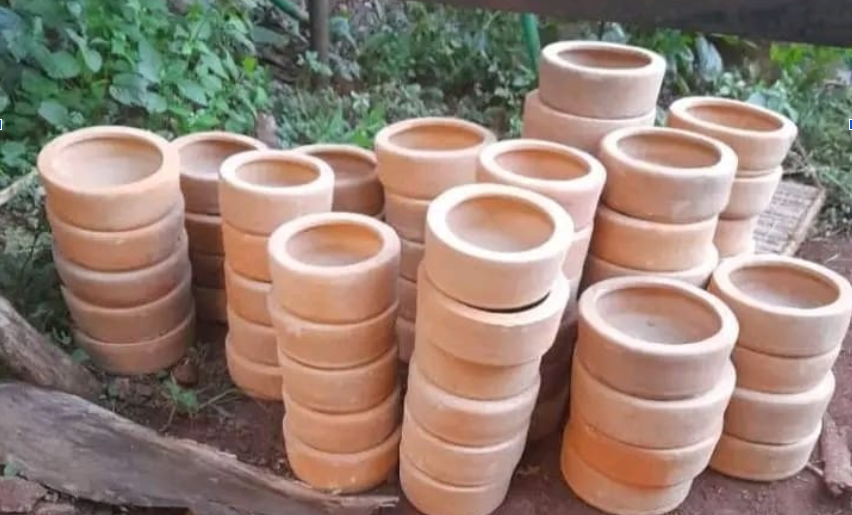
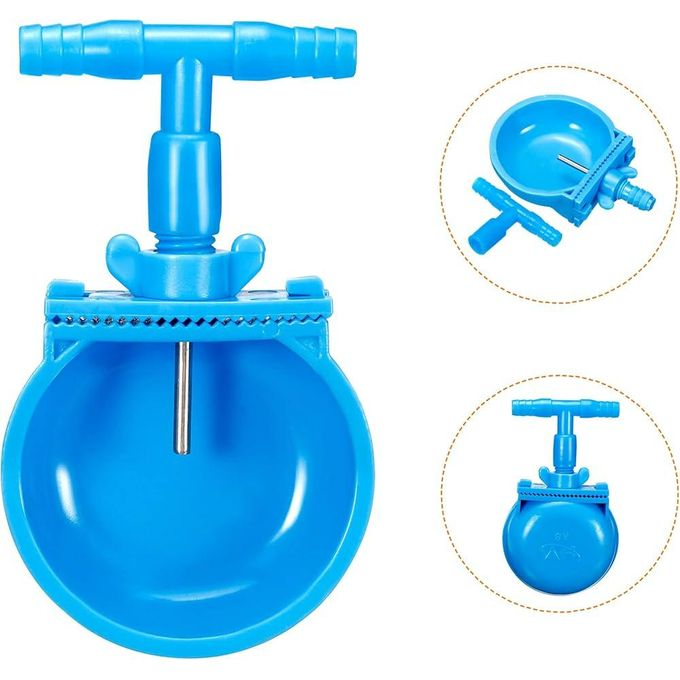
Beyond cages, each hutch needs a feeding pot and a drinker. Quality rabbit feeders and drinkers are a modest but necessary purchase poorly designed equipment leads to feed wastage and contaminated water, both of which affect growth rates. Factor these into your initial budget alongside the cage cost.
Here is what the startup investment looks like at three common farm sizes:
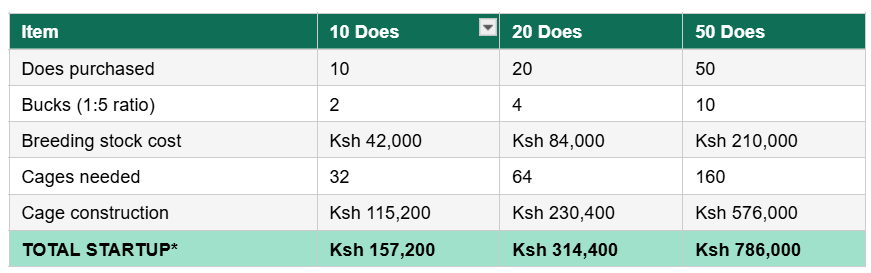
* Excludes feeders, drinkers, and disease management kit. Budget an additional Ksh 2,000–5,000 depending on farm size.
| Note on spaceA 10-doe operation needs no more land than a typical Nairobi backyard. Using stacked cages, 32 cages fit comfortably in a 4×4 metre structure. You do not need agricultural land rabbit farming is viable in urban backyards and peri-urban plots. |
Monthly Running Costs: What You Pay to Keep the Farm Going
Feed is your biggest, ongoing cost, and it is straightforward to calculate. Rabbits eat pelleted feed supplemented with hay.
- Breeder Feed
A mature doe or buck eats 100g of pellets per day. At Ksh 55 per kg, that is Ksh 165 per breeder per month. For a 10-doe farm with 2 bucks, monthly breeder feed costs Ksh 1,980.
- Kit Feed
Kits spend their first month nursing– no pellet cost. From month two, feed intake rises progressively: 25g per day in month two, 45g per day in month three, then 75g per day through to sale at month five. The average feed cost per kit across its four feeding months is approximately Ksh 363.
- Hay
A bale of hay costs Ksh 250 and lasts several days across your cage population. It is a minor cost but important, hay makes upto 75% of the rabbit feed. It supports gut health and keeps feed conversion efficient.
- Labour
This is where rabbit farming stands apart from other livestock. Feeding, cleaning, and health checks for a 20-doe farm take under 2 hours per day. No specialist skills, no hired hands at a small scale. The work is suitable for family members and can run alongside a full-time job or other farming activities.
We recommend hiring a full-time employee for farms with 100 or more breeders.
- Veterinary and Disease Management
Rabbits are hardy. With proper cage hygiene and a balanced diet, disease incidence is low. That said, a basic disease management kit is an essential part of your setup. This should include a multivitamin supplement, a dewormer, and a broad-spectrum antibiotic for emergency use.
Rabbit Choice Farms advises all registered farmers on what to keep on hand and how to use it. Budget a contingency of Ksh 500–1,000 per month in the early months; experienced farmers often spend nothing here for months at a time.
How Much Money Can You Make? The Income Model Explained
Before the scenario tables, here is the logic so the numbers make sense:
- Each doe gives birth every 2 months, producing an average of 6 kits per litter.
- Applying a realistic 6% mortality rate, approximately 5.64 kits per doe survive to sale age per litter.
- Kits are sold at 5 months old, at approximately 3 kg live weight.
- Rabbit Choice Farms purchases from registered contract farmers at Ksh 300 per kg live weight Ksh 900 per kit.
- Because litters are born on a rolling 2-month cycle, income flows every month, not once a season.
The depreciation figures account for cage replacement (5-year life) and breeder restocking (3-year productive life) costs that matter for accurate profit calculation.
Scenario A: 10 Does (Starter Farm)
This is the ideal entry point for a first-time rabbit farmer. The capital requirement is manageable, the daily workload is light, and you will have a clear operational picture before considering any expansion.
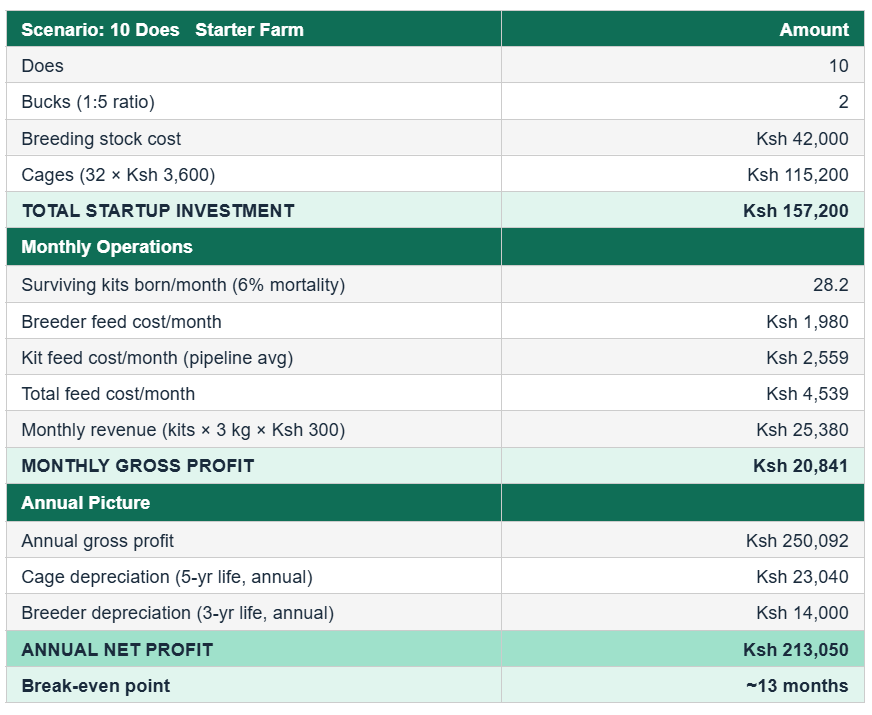
At 10 does, your farm generates Ksh 25,380 in monthly revenue against Ksh 4,539 in feed costs a gross profit of Ksh 20,841 per month. After accounting for annual depreciation on cages and breeding stock, you clear Ksh 213,050 in annual net profit. Your full startup investment of KSh 157,200 is recovered in approximately 13 months.
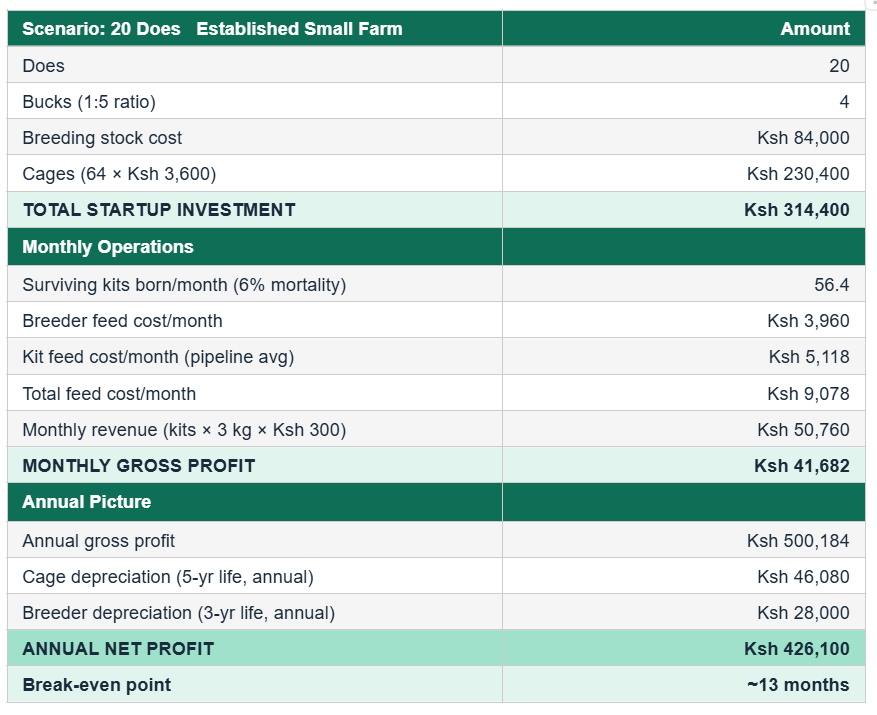
Scenario B: 20 Does (Established Small Farm)
Twenty does is where rabbit farming starts to feel like a serious business. The income is meaningful enough to cover household expenses or fund further expansion, and the workload remains manageable for one person part-time.
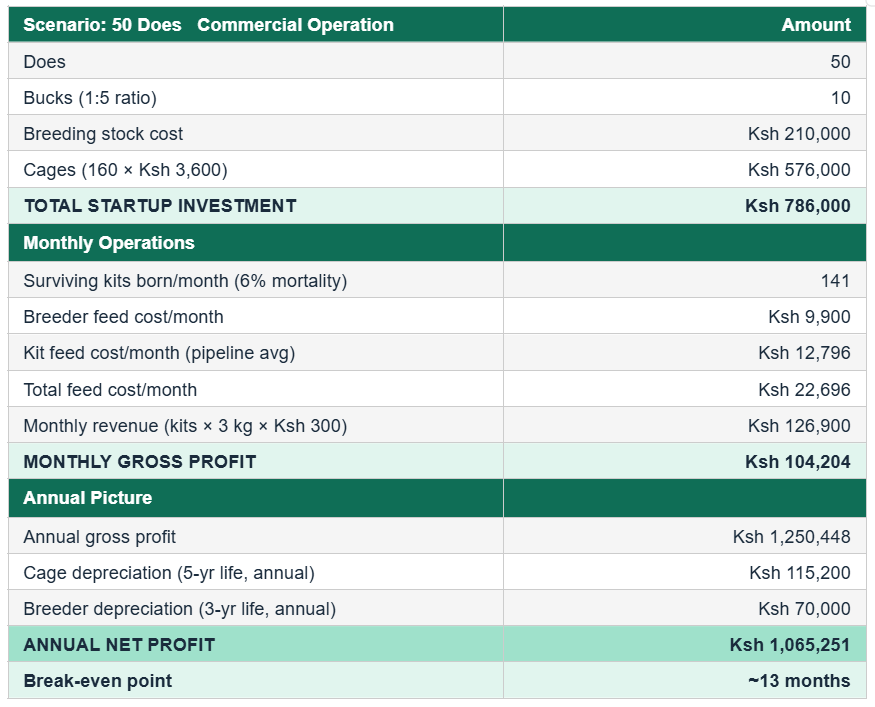
Scenario C: 50 Does (Commercial Operation)
At 50 does, this is a full commercial rabbit farm. You will need part-time help for feeding and daily management, but the economics are compelling.
Why Rabbit Farming Works for Kenyan Farmers
The income projections above are only part of the story. The structural advantages of rabbit farming are what make those numbers achievable in practice.
- Minimal Space Requirements– Rabbits live in stacked cages, not open pasture. A 50-doe commercial operation can run from a structure the size of a large room. This makes rabbit farming viable for urban and peri-urban farmers with no land, something dairy or beef cattle production can never offer.
- Low Labour Demand. Feeding and daily checks for a 20-doe farm take under 2 hours per day. The work does not require physical strength, specialist training, or constant supervision. Farmers run successful rabbit operations alongside full-time employment. Families manage them as a joint household enterprise. Few other livestock businesses offer this flexibility.
- Hardy Animals, Low Veterinary Bills– Rabbits are naturally resilient animals. Unlike poultry, which are vulnerable to devastating disease outbreaks, well-managed rabbits rarely fall ill. Clean cages, proper feeding, and a basic disease management kit are the main health inputs. The 6% mortality assumption in the projections above is deliberately conservative; many farmers do better.
- Fast Cash Flow– A doe produces kits every 2 months. Those kits are ready for sale at 5 months. From the moment your first doe kindles, you are 5 months from your first revenue, and after that, money comes in every month on a rolling cycle. Rabbit farming does not tie up capital for years before returning meaningful income.
- Easy to Handle and Scale– No dangerous animals. No heavy equipment. No specialised infrastructure. A first-time farmer can learn the basics in a single farm visit with Rabbit Choice Farms and be fully operational within weeks. When you are ready to scale, you add more cages and buy more breeders since the system is linear and predictable.
Frequently Asked Questions
Is rabbit farming profitable in Kenya?
Yes, it can be profitable with proper management. A small farm can generate a steady monthly income after the initial setup period. The key to profitability is managing feed costs carefully, maintaining consistent litter production, and having a guaranteed market for your output, which Rabbit Choice Farms’ contract farming programme provides.
What equipment do I need to start a rabbit farm?
Beyond cages and breeding stock, every rabbit farm needs feeding pots and drinkers for each hutch. Purpose-made rabbit feeders prevent feed wastage and keep water clean.
You also need a basic disease management kit: a multivitamin supplement to support immunity, a dewormer to be used regularly to control internal parasites, and an antibiotic on hand for bacterial infections. Rabbit Choice Farms supplies guidance on the correct products and dosages when you purchase your breeders.
How many kits does a rabbit produce per year?
A productive doe gives birth approximately every 2 months, producing an average of 6 kits per litter. That is around 36 kits per doe per year before mortality. Applying a 6% mortality rate, a farmer can realistically expect approximately 34 kits per doe to reach sale age each year.
Where can I sell my rabbits in Kenya?
Rabbit Choice Farms buys directly from farmers, a guaranteed offtake market that removes the guesswork from sales. The rabbits have to be hybrid, healthy, kept in self-cleaning cages, and fed on dry matter like rabbit pellets and hay. The minimum weight we take per rabbit is 2.5 kg.
Demand for rabbit meat in Nairobi is growing and consistently outstrips local supply, which is why the contract farming programme exists. Outside of Rabbit Choice Farms, other sales channels include local butcheries, direct consumer sales, and hotels and restaurants catering to health-conscious diners.
What do Rabbits Eat?
Commercial rabbits are fed a combination of pelleted feed and hay, both of which play different but essential roles in their nutrition.
- Hay should make up about 70–75% of a rabbit’s diet and must be available at all times. It supports digestion, prevents gut-related diseases, and improves overall feed efficiency. Rabbits should have constant access to clean, dry hay throughout the day.
- Pellets provide concentrated nutrients such as protein, vitamins, and minerals. In Kenya, pellets cost approximately KSh 55 per kg. A mature breeder consumes about 100g of pellets per day.
- Kits begin eating pellets from their second month, with intake increasing gradually:
- Month 2: ~25g/day
- Month 3: ~45g/day
- Month 4–5: ~75g/day
- Clean drinking water must also be available at all times. Continuous access to fresh water is critical for feed digestion, growth, and overall health.
A consistent feeding routine with unlimited hay, measured pellets, and constant clean water is key to maintaining healthy rabbits and achieving good growth rates.
How much space do I need to start a rabbit farm?
Rabbit farming requires relatively little space compared to other livestock because rabbits are kept in cages rather than on open land.
A standard rabbit cage measures approximately 2 feet wide × 2.5 feet long × 2 feet high, which is sufficient for one adult rabbit. These cages are designed for easy feeding, cleaning, and proper movement.
To maximize space, cages are typically stacked vertically in 2 or 3 tiers. This allows multiple cages to occupy the same floor area, making it possible to run a larger operation within a small structure.
- A 10-doe setup (32 cages) can fit within a 4×4 metre structure using a two-tier stacked system.
- A 50-doe commercial setup can operate within a space roughly equivalent to a large room or small shed, depending on layout and stacking.
Because of this efficient use of space, rabbit farming can be done in urban backyards, small compounds, and peri-urban areas. The key requirements are good ventilation, proper hygiene, and protection from rain, heat, and wind.
Does Rabbit Choice Farms offer training for new rabbit farmers?
Yes. Rabbit Choice Farms provides hands-on training for all farmers who purchase breeders from us, covering feeding schedules, health management, litter handling, record-keeping, and cage hygiene. We also offer ongoing consultancy as your farm grows. Our goal is for every farmer we work with to run a profitable, sustainable operation because the better you do, the more supply we receive.
Ready to Start? Here’s Your Next Step
Rabbit farming in Kenya can be a practical and profitable venture when it is set up correctly. As shown in this guide, it is possible to start small, recover your investment within a reasonable time, and scale gradually into a reliable source of income.
In most cases, the difference between success and struggle comes down to three things:
- Starting with the right breeding stock
- Setting up proper housing
- Having a clear plan for production and sales
Getting these right from the beginning saves time, money, and costly mistakes.
If you are considering starting or want to improve an existing setup, you are welcome to visit us for a free consultation. We can walk you through the practical requirements, help you plan your setup based on your space and budget, and answer any questions you may have.
Starting with the right information makes all the difference. Feel free to reach out or stop by. We are happy to help you get it right from day one.
Visit us at: Total Ruaraka Mall, Thika Road (opposite Safari Park Hotel), Nairobi
Call or WhatsApp: 0715 626 955
Read on
How to Choose the Best Rabbit Breeds for Commercial Rabbit Farming
Thank you for the information.Looking forward to partnering with your company
Interested